
How Much Does Aluminium Decking for Balconies Cost in Australia?
Published: May 29, 2026
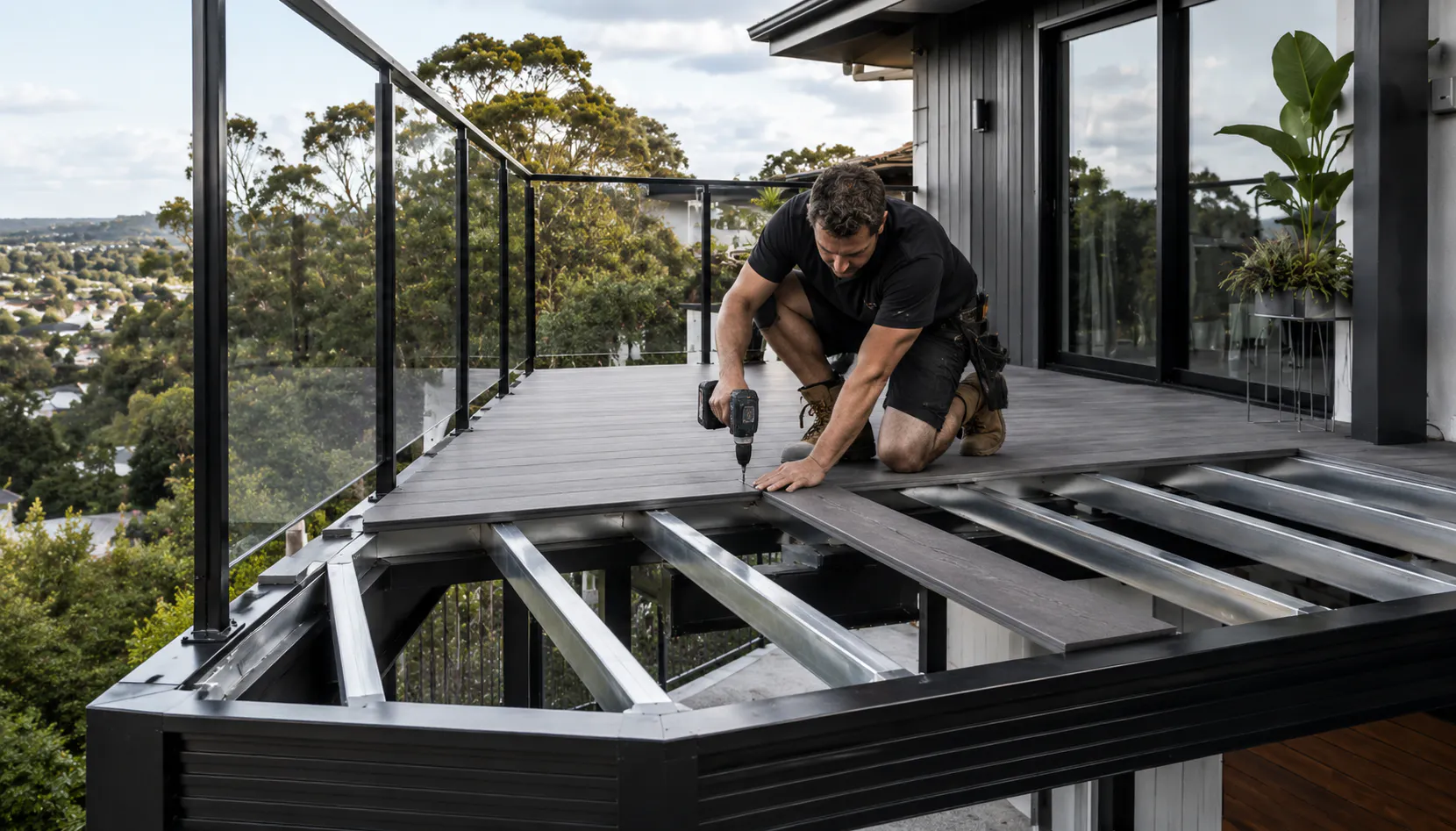
Table of Contents
- 01
- 02
- 03
- 04
- 05
- 06
- 07
A fully installed decking project in Australia can range from $200 to over $1,000 per square metre. The material type chosen directly impacts the cost. Aluminium sits at the top end of this range when you factor in boards, the subframe, labour, and finishing. Choose the material for your balcony decking after weighing in the advantages and disadvantages of each type. Depending on your balcony size, the material you choose, as well as your location, the aluminium decking for balconies cost will vary.
Below, we break down what drives balcony decking costs, how aluminium stacks up against timber and composite over the long run, and how to get an accurate subframe estimate for your project.
Key Takeaways
- Aluminium balcony decking costs more upfront than timber or composite. Over 10–20 years, it's the cheapest option because there's almost nothing to maintain.
- The subframe (joists, bearers, pedestals, connectors) is one of the biggest line items. The Spanmor decking calculator prices it directly at $105–$200 per m² for residential joist sizes.
- Lighter 105x50mm joists are cheaper on materials but need more posts and more labour to install. Heavier 170x50mm joists cost more per metre but go in faster with fewer supports. The installed price gap between them is smaller than the material price gap.
- Balconies aren't backyard decks. Budget for waterproof membrane protection, fire ratings, crane access, drainage engineering, and council approvals on top of materials.
- Boards and labour need separate builder quotes in addition to the cost of the aluminium subframe.
Compare Aluminium, Timber and Composite Material Choices for Balcony Decking
The cost of decking for your balcony is mostly based on the material you select:
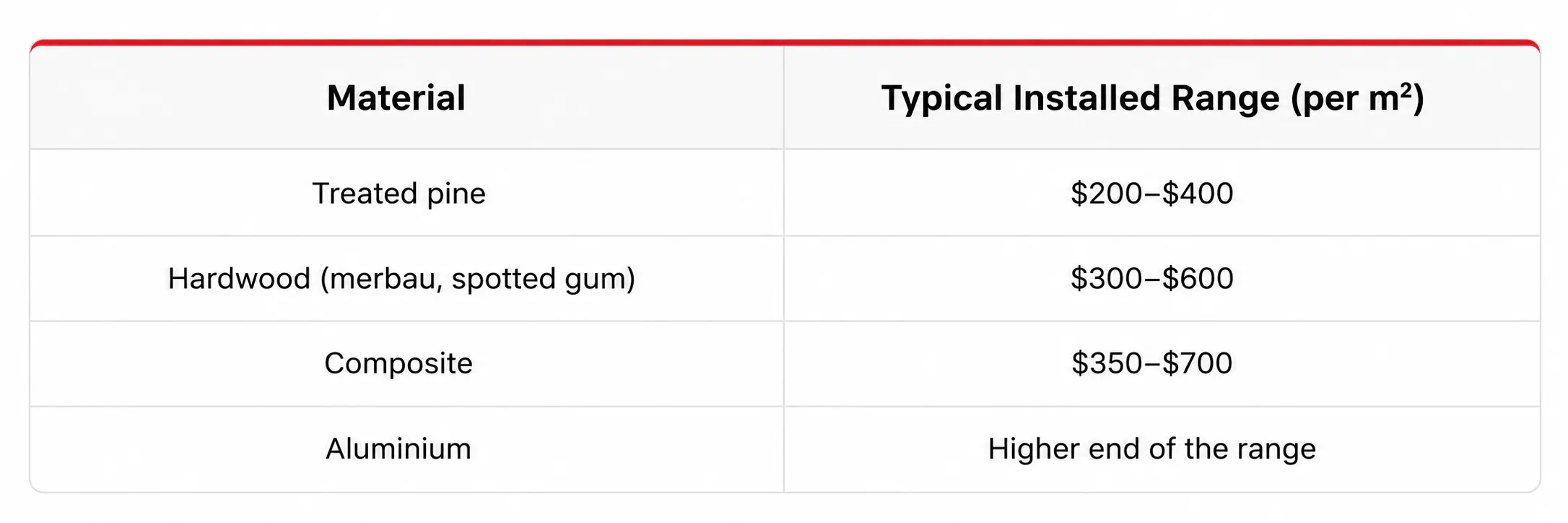
Each material has its own pros and cons when it comes to decking for balconies.
Aluminium decking for balconies costs more compared to other options like pine or hardwood. While that may immediately lead you to believe the cheaper option is better, there’s a bigger picture.
Although treated pine decking is roughly half to a third of what you'd pay for a comparable aluminium decking system, timber needs oiling one to two times a year (DIY cost of $50–$100 per treatment, or $25–$60 per square metre if you hire someone).
If it were only the maintenance costs, one could even say this option is profitable. But factor in the replacement of rotted or split boards; suddenly timber is just as expensive as aluminium, with the addition of repairs.
Now composite sits in the middle, requiring lower maintenance than timber, but not zero. Some composites can fade, stain, or sag in extreme Australian heat, depending on the brand and quality tier.
Yes, aluminium costs more on day one. But with a 25-year-plus lifespan, no oiling, no sanding, no staining, no board replacements, and no termite risk, the total ownership cost over 10–20 years is lower than both timber and composite.
If you're planning to stay in your home long-term or you simply don't want to spend weekends maintaining a deck, the maths tends to favour aluminium.
Spanmor Aluminium Subframe Costs
The subframe is the structural skeleton underneath your aluminium decking boards holding joists, bearers, pedestals, and connectors. It's one of the biggest cost components, and it's the part that the Spanmor decking calculator prices directly for you.
The calculator presents three joist options. For most residential balconies, you're choosing between the first two:
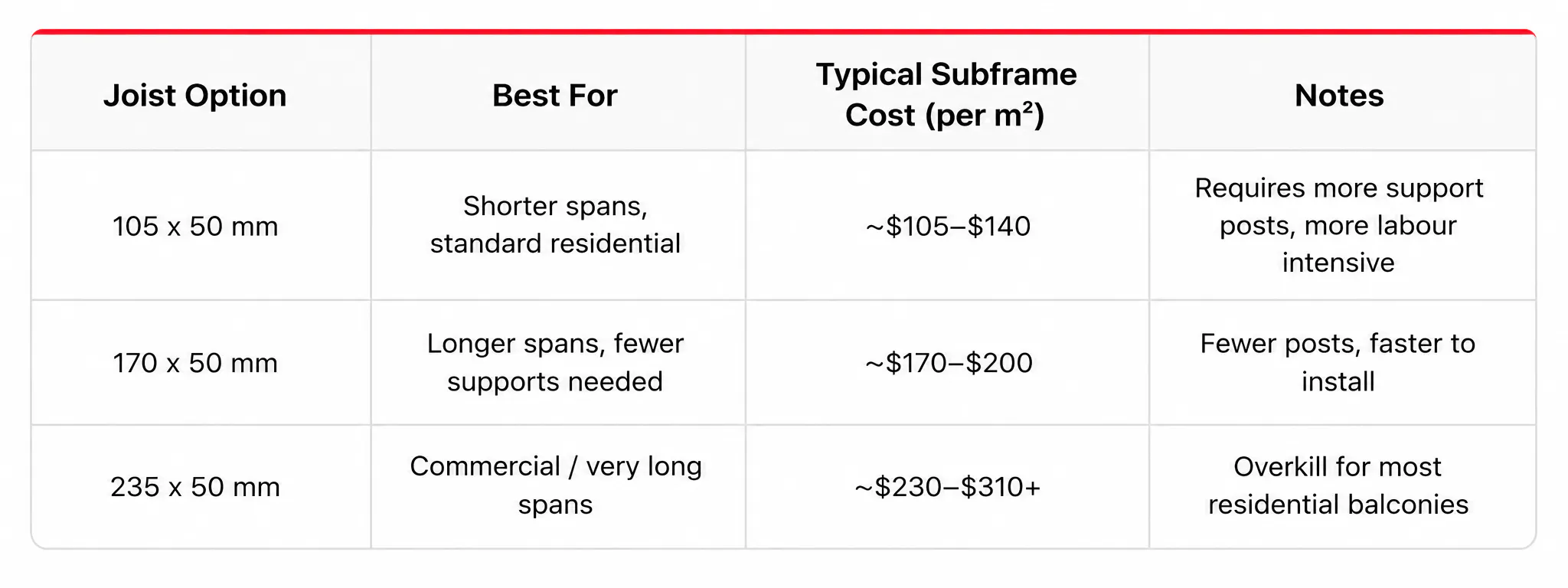
These figures come straight from the calculator at the current RRP (recommended retail price). Larger decks trend towards the lower end of each range thanks to economies of scale.
One thing worth knowing is that the cheapest subframe isn't always the cheapest installed option.
The 105x50mm joists cost less in materials but need more support posts and more labour hours. The 170x50mm option costs more per metre but spans further with fewer posts, so your installer works faster. So the gap in your final quote will be narrower than the gap in raw material cost.
Important: The calculator prices the subframe only, not decking boards, fascia, finishing, or installation labour. You'll need to factor those in separately when budgeting the full project. It does, however, generate a downloadable PDF with layout drawings and a waste-minimised materials list, which takes the guesswork out of ordering.
Get your subframe priced via our calculator or head to our companion guide on aluminium decking for balconies cost per square foot for a more detailed breakdown of per-unit pricing.
7 Critical Factors Affecting the Cost of an Aluminium Balcony Deck
In addition to the choice of subframe material, aluminium decking for balconies cost will vary based on the following:
1. Balcony Size and Shape
Larger balconies bring the per-square-metre cost down slightly because fixed costs like site setup, delivery, and mobilisation get spread across a wider area. But complex shapes such as L-shaped balconies, curves, or multiple step-downs require more labour hours.
2. Height and Access
A ground-floor balcony where the installer can walk materials straight in is the cheapest scenario. Upper-floor balconies in apartment buildings are usually more expensive as they need crane lifts, scaffolding, or restricted-hours access through common areas.
3. Board Profile and Finish
Owing to the type of finish you select, not all aluminium decking for balconies cost the same. Standard powder-coated profiles are the most affordable. Woodgrain-look finishes that mimic the appearance of natural timber cost more. Premium anti-slip coatings and custom colours add to the price.
4. Waterproof Membrane Protection
Balconies sit above habitable spaces, which means protecting the waterproof membrane underneath is necessary. Aluminium subframe systems placed above the membrane without penetrating it are specifically designed for this. However, the additional engineering and pedestal components add to the cost compared to a standard ground-level deck.
5. Structural Engineering and Council Approvals
Depending on your state and council, balcony decking projects will require a structural engineer's report, a development application, or a complying development certificate. Engineering fees can run between $500–$2,000. Council permits range from $200–$1,500. These are regulatory requirements that need to be budgeted for.
6. Bushfire Compliance
If your property is in a designated bushfire zone, your decking materials need to meet a specific Bushfire Attack Level (BAL) rating. Aluminium is non-combustible and meets the highest BAL ratings, which is one of the reasons it's specified for balconies on multi-storey buildings. However, BAL-compliant projects will require additional documentation and sometimes higher-spec components, which adds to the total cost.
7. Coastal Location
Salt air is brutal on building materials. Timber decking in coastal areas can deteriorate significantly within a decade, even with regular maintenance. Aluminium's natural corrosion resistance makes it a strong choice for coastal balconies, but marine-grade powder coating and stainless steel fixings (which you'll want within a few kilometres of the coast) come at a premium over standard inland specifications.
Aluminium Decking for Balconies Cost-Saving Tips from Spanmor
- Use the Spanmor calculator to eliminate subframe waste: Accurate measurements mean you order exactly what you need with no expensive leftover joists and connectors.
- Choose standard rectangular layouts where possible: Custom angles and curves increase cutting, waste, and labour time.
- Consider an aluminium subframe with composite boards: If full aluminium decking exceeds your budget, you can still get the structural durability of aluminium underneath with a lower-cost surface material on top.
- Get at least three quotes: Make sure each one itemises the subframe, boards, labour, and permits separately to compare properly.
- Think long-term: If you're choosing between a cheaper timber deck you'll maintain for 20 years and an aluminium deck you won't, run the numbers over the full ownership period before deciding.
- Bundle your order: If you're also building a pergola or doing other structural work, combining materials through a single supplier like Spanmor can reduce delivery costs and sometimes unlock better pricing.
Need Help With Your Aluminium Balcony Decking Project?
If you've got questions about joist sizing, system selection, or how Spanmor's aluminium subframe fits your specific balcony, talk to an expert. Our team can walk you through the options. We’ll help you interpret your calculator results and connect you with installers in your area.
Categories
Build Smarter with Aluminium You Can Trust
Dive into expert insights, guides, and practical advice on aluminium framing, decking systems, pergolas, and outdoor living solutions.

Sales Representative
Updated: May 29, 2026
Published: May 29, 2026
Categories
Build Smarter with Aluminium You Can Trust
Dive into expert insights, guides, and practical advice on aluminium framing, decking systems, pergolas, and outdoor living solutions.
 Spanmor Aluminium System - Limited Warranty